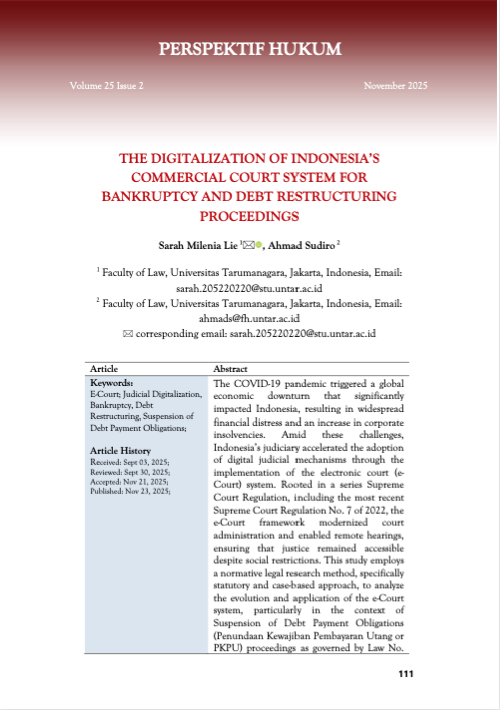
The Digitalization of Indonesia’s Commercial Court System for Bankruptcy And Debt Restructuring Proceedings
Digitalisasi Sistem Peradilan Niaga Indonesia untuk Proses Kepailitan dan Restrukturisasi Utang
DOI:
https://doi.org/10.30649/ph.v25i2.458Keywords:
E-Court, Judicial Digitalization, Bankruptcy, Debt Restructuring, Suspension of Debt Payment ObligationsAbstract
he COVID-19 pandemic triggered a global economic downturn that significantly impacted Indonesia, resulting in widespread financial distress and an increase in corporate insolvencies. Amid these challenges, Indonesia’s judiciary accelerated the adoption of digital judicial mechanisms through the implementation of the electronic court (e-Court) system. Rooted in a series Supreme Court Regulation, including the most recent Supreme Court Regulation No. 7 of 2022, the e-Court framework modernized court administration and enabled remote hearings, ensuring that justice remained accessible despite social restrictions. This study employs a normative legal research method, specifically statutory and case-based approach, to analyze the evolution and application of the e-Court system, particularly in the context of Suspension of Debt Payment Obligations (Penundaan Kewajiban Pembayaran Utang or PKPU) proceedings as governed by Law No. 37 of 2004. Using the Garuda Indonesia case (Decision No. 425/Pdt.Sus-PKPU/2021/PN.Niaga.Jkt.Pst.) as a reference, the research highlights how e-Court supported judicial continuity and upheld the principles of simplicity, promptness, and affordability as mandated under Article 2(4) of Law No. 48 of 2009 on Judicial Power. The findings underscore e-Court’s crucial role in maintaining economic and judicial resilience, while also identifying challenges regarding procedural legitimacy, technological literacy, and equitable access.
Downloads
References
Harwati, T. Peradilan di Indonesia. Sanabil, 2015. ISBN 978-602-74024-5-4
Muhammad, A. Hukum dan Penelitian Hukum. Bandung: Citra Aditya Bakti, 2004
Nugroho, S. A. Hukum Kepailitan di Indonesia dalam Teori dan Praktik serta Penerapan Hukumnya. Jakarta: Prenadamedia Group, 2018
Nuraeni, Y., L. Judijanto, S. Sufiarina, and L. A. Sihombing. Hukum Acara Peradilan Niaga: Teori dan Implementasinya di Indonesia. PT Sonpedia Publishing Indonesia, 2024
Soekanto, S., and S. Mamudji. Penelitian Hukum Normatif. Jakarta: Raja Grafindo Persada, 2003
Ang, I., and G. Lie. “Penundaan Kewajiban Pembayaran Utang dalam Kasus PT Garuda Indonesia.” RIGGS: Journal of Artificial Intelligence and Digital Business 4, no. 3 (2025): 6319–6325
Atikah, I. “Implementasi E-Court dan Dampaknya terhadap Advokat dalam Proses Penyelesaian Perkara di Indonesia.” In Open Society Conference, vol. 107 (2018), 127–134
Ariwijaya, A. R., and P. L. Samputra. “Evaluasi Kebijakan Peradilan Elektronik (E-Court) Mahkamah Agung Republik Indonesia.” Jurnal Hukum & Pembangunan 51, no. 4 (2022): 1104–1122. https://doi.org/10.21143/jhp.vol51.no4
Handayani, D. “Efektivitas E-Court Perkara Perdata Masa Pandemi dan Pascapandemi COVID-19 di Makassar.” Masalah-Masalah Hukum 52, no. 2 (2023): 119–130. https://doi.org/10.14710/mmh.52.2.119-130
Hariyanto, E., and S. Sundusiyah. “Implementasi Peraturan Mahkamah Agung tentang E-Court untuk Mewujudkan Asas Sederhana, Cepat, dan Biaya Ringan di Pengadilan Agama Pamekasan.” Arena Hukum 15, no. 3 (2022): 471–498. https://doi.org/10.21776/ub.arenahukum.2022.01503
Kamello, T., and M. Sastro. “The Development of Procedural Law Through the E-Court System After the Pandemic in Indonesia.” Veteran Law Review 6, Special Issue (2023): 15–27
Lahilote, H. S., S. Sabarudin, and I. Abdullah. “Digitalisasi Peradilan di Indonesia Tengah: Studi Implementasi E-Court dan E-Litigasi di Pengadilan.” Syariah: Jurnal Hukum dan Pemikiran 24, no. 2 (2024): 315–332. https://doi.org/10.36448/pranatahukum.v14i1.162
Mantili, R., and P. E. T. Dewi. “Penundaan Kewajiban Pembayaran Utang (PKPU) Terkait Penyelesaian Utang Piutang dalam Kepailitan.” Jurnal Aktual Justice 6, no. 1 (2021): 1–19
Oelangan, M. D. “Penyelesaian Sengketa Bisnis Melalui Pengadilan Niaga.” Pranata Hukum 14, no. 1 (2019): 522–593. https://doi.org/10.36448/pranatahukum.v14i1.162
Putra, Dedi. "A modern judicial system in Indonesia: legal breakthrough of e-court and e-legal proceeding." Jurnal Hukum dan Peradilan 9.2 (2020): 275-297
Retnaningsih, S., D. L. S. Nasution, R. A. Velentina, and K. Manthovani. “Pelaksanaan E-Court Menurut PERMA Nomor 3 Tahun 2018 tentang Administrasi Perkara di Pengadilan secara Elektronik dan E-Litigation menurut PERMA Nomor 1 Tahun 2019 tentang Administrasi Perkara dan Persidangan di Pengadilan secara Elektronik (Studi di Pengadilan Negeri di Indonesia).” Jurnal Hukum & Pembangunan 50, no. 1 (2020): Article 8. https://doi.org/10.21143/jhp.vol50.no1.2486
Sari, Ni Putu Riyani Kartika. "Eksistensi E-Court Untuk Mewujudkan Asas Sederhana, Cepat, Dan Biaya Ringan Dalam Sistem Peradilan Perdata Di Indonesia." Jurnal Yustitia 13.1 (2019): 80-100
Syarif, Z. “Asas Peradilan Sederhana, Cepat, dan Biaya Ringan dalam Ketentuan Persidangan Hybrid Perkara Perdata.” Collegium Studiosum Journal 7, no. 1 (2024): 193–203
ASEAN Stats. “ASEAN Gross Domestic Product (GDP) Annual.” August 26, 2025. https://data.aseanstats.org/asean-gdp-annual.
Badan Pusat Statistik. “Ekonomi Indonesia 2020 Turun Sebesar 2,07 Persen (c-to-c).” February 5, 2021. Accessed August 26, 2025. https://www.bps.go.id/id/pressrelease/2021/02/05/1811/ekonomi-indonesia-2020-turun-sebesar-2-07-persen--c-to-c-.
Constitution of the Republic of Indonesia (Undang-Undang Dasar 1945)
Law No. 37 of 2004 concerning Bankruptcy and Suspension of Debt Payment Obligations (Undang-Undang No. 37 Tahun 2004 tentang Kepailitan dan Penundaan Kewajiban Pembayaran Utang)
Law Number 48 of 2009 concerning Judicial Power (Undang-Undang Nomor 48 Tahun 2009 tentang Kekuasaan Kehakiman)
Law No. 1 of 2024 concerning the Second Amendment to Law No. 11 of 2008 on Electronic Information and Transactions (Undang-undang Nomor 1 Tahun 2024 tentang Perubahan Kedua atas Undang-Undang Nomor 11 Tahun 2008 tentang Informasi dan Transaksi Elektronik)
Supreme Court Regulation of the Republic of Indonesia No. 3 of 2018 on Electronic Court Administration (Peraturan Nomor 3 Tahun 2018 Mahkamah Agung tentang Administrasi Perkara di Pengadilan Secara Elektronik)
Supreme Court Regulation of the Republic of Indonesia No. 1 of 2019 on Case Administration and Court Proceedings Electronically (Peraturan Mahkamah Agung Republik Indonesia Nomor 1 Tahun 2019 tentang Administrasi Perkara dan Persidangan di Pengadilan Secara Elektronik)
Supreme Court Regulation of the Republic of Indonesia No. 7 of 2022 concerning Amendments to Supreme Court Regulation No. 1 of 2019 on Case Administration and Court Proceedings Electronically (Peraturan Mahkamah Agung Republik Indonesia Nomor 7 Tahun 2022 tentang Perubahan Atas Peraturan Mahkamah Agung Nomor 1 Tahun 2019 tentang Administrasi Perkara dan Persidangan di Pengadilan secara Elektronik)
Downloads
Published
How to Cite
License
Copyright (c) 2025 All writings published in this journal are personal views of the authors and do not represent the views of this journal and the author's affiliated institutions. Author(s) retain copyrights under the licence of Creative Commons Attribution-ShareAlike 4.0 International (CC BY-SA 4.0).

This work is licensed under a Creative Commons Attribution-ShareAlike 4.0 International License.