Extradition Agreement and Police to Police Cooperation in The Lens of Responsive Law
Perjanjian Ekstradisi dan Kerja Sama Antar Kepolisian dalam Perspektif Hukum Responsif
DOI:
https://doi.org/10.30649/ph.v26i1.459Keywords:
Extradition, Responsive Law, Police to PoliceAbstract
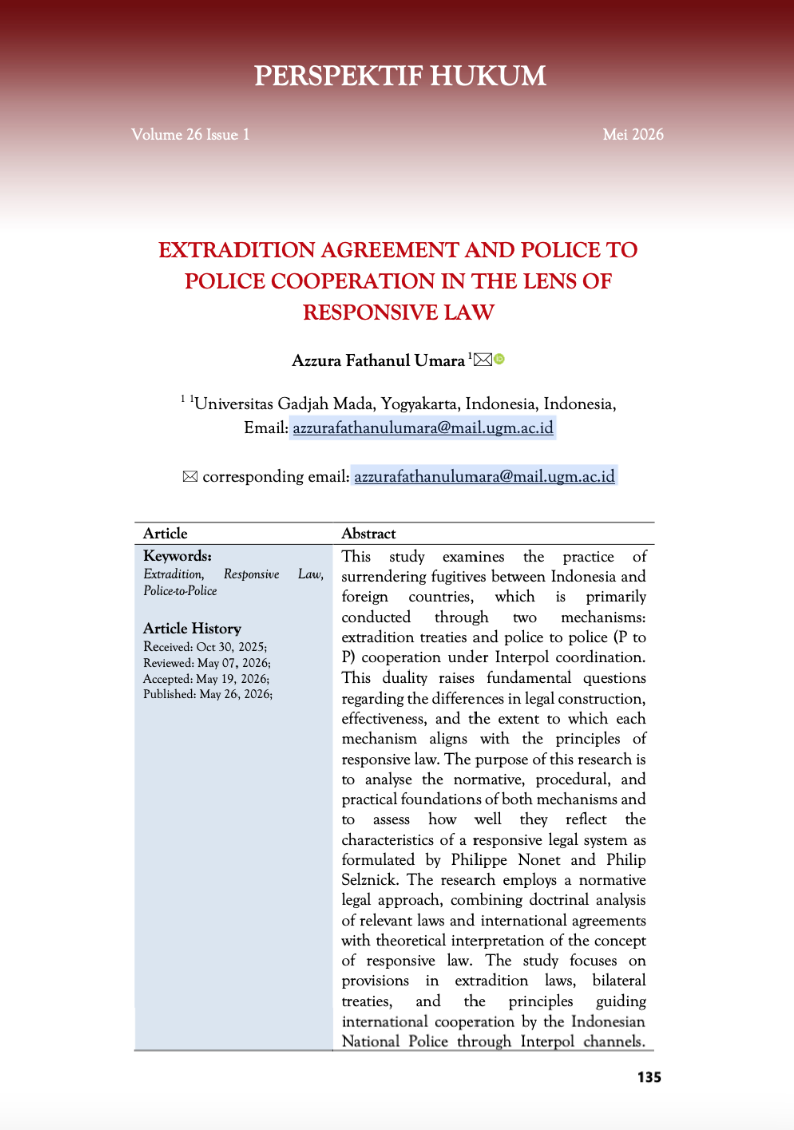
This study examines the practice of surrendering fugitives between Indonesia and foreign countries, which is primarily conducted through two mechanisms: extradition treaties and police to police (P to P) cooperation under Interpol coordination. This duality raises fundamental questions regarding the differences in legal construction, effectiveness, and the extent to which each mechanism aligns with the principles of responsive law. The purpose of this research is to analyse the normative, procedural, and practical foundations of both mechanisms and to assess how well they reflect the characteristics of a responsive legal system as formulated by Philippe Nonet and Philip Selznick. The research employs a normative legal approach, combining doctrinal analysis of relevant laws and international agreements with theoretical interpretation of the concept of responsive law. The study focuses on provisions in extradition laws, bilateral treaties, and the principles guiding international cooperation by the Indonesian National Police through Interpol channels. The findings indicate that the extradition mechanism, with its formal legal basis and strong inter-state obligations, more closely embodies a responsive legal system by ensuring accountability, transparency, and legal certainty. In contrast, the P to P mechanism—while more flexible and efficient in practice—tends to be pragmatic and does not fully reflect the principles of legal responsiveness. Nevertheless, its flexibility and efficiency make P to P the preferred operational choice for law enforcement agencies in handling cross-border fugitive cases. In short, extradition treaty should be the default choice in an ideal situation where the clauses are applicable and P to P is the choice that can be used when the condition requires flexibility and pragmatism, especially when there is no extradition treaty that can be used as a base to extradite.
Downloads
References
Budiarto, M. Ekstradisi Dalam Hukum Nasional. Cet. Pertama. Ghalia Indonesia, 1981.
Budiarto, M. Masalah Ekstradisi Dan Jaminan Perlindungan Atas Hak Asasi Manusia. Cet. Pertama. Ghalia Indonesia, 1980.
Diantha, I. Made Pasek. Hukum Pidana Transnasional: Suatu Studi Awal. Pertama. Kencana, 2020.
Maringka, Jan S. Ekstradisi Dalam Sistem Peradilan Pidana. Cet. Pertama. Sinar Grafika, 2019.
Nonet, Phillippe, and Philip Selznick. Toward Responsive Law: Law and Society in Transition. Routledge, 2017.
Parthiana, I. Wayan. Hukum Pidana Internasional Dan Ekstradisi. Cet. Pertama. Yrama Widya, 2003.
Piaget, Jean. The Moral Judgement of the Child. The Free Press, n.d.
Rawls, John. A Theory of Justice. Revised Edition. Harvard University Press, 1999.
Sunarso, Siswanto. Ekstradisi Dan Bantuan Timbal Balik Dalam Masalah Pidana Instrumen Penegakan Hukum Pidana Internasional. Cet. Pertama. Rineka Cipta, 2009.
Apriyani, Maria Novita, Miko Aditiya Suharto, and Waluyo Waluyo. “Pembaruan Peraturan Ekstradisi Dan Mutual Legal Assistance Indonesia Dalam Pengembalian Aset Hasil Korupsi Yang Berada Di Luar Negeri.” CREPIDO 5, no. 1 (2023): 27–41. https://doi.org/10.14710/crepido.5.1.27-41.
Calcara, Giulio. “A Transnational Police Network Co-Operating up to the Limits of the Law: Examination of the Origin of INTERPOL.” Transnational Legal Theory 11, no. 4 (2020): 521–48. https://doi.org/10.1080/20414005.2020.1793282.
Krcmaric, Daniel. “Nowhere to Hide? Global Policing and the Politics of Extradition.” International Security 47, no. 2 (2022): 7–47. https://doi.org/10.1162/isec_a_00444.
Medeham, Sam. “Weaponizing the Police: Authoritarian Abuse of Interpol.” Harvard International Review 43, no. 2 (2022): 6–11.
Nemets, Y. L., Austin Wahl, Simran Pandey, Morinsola Tinubu, and Bruce Zagaris. “Extradition and Interpol.” International Enforcement Law Reporter 40, no. 9 (2024): 379–88.
Nuban, Julio Benyamin, Dhesy A. Kase, and Elisabeth N. S. B. Tukan. “Tinjauan Yuridis Pelaksanaan Perjanjian Ekstradisi Indonesia-Malaysia (Studi Kasus: Djoko Soegiarto Tjandra).” Artemis Law Journal 2, no. 1 (2024): 14–29. https://doi.org/10.35508/alj.v2i1.16170.
San, Serdar. “Transnational Policing between National Political Regimes and Human Rights Norms: The Case of the Interpol Red Notice System.” Theoretical Criminology 26, no. 4 (2022): 601–19. https://doi.org/10.1177/13624806221105280.
Aprilia, Zefanya. “Begini Cerita Di Balik Penangkapan Buron Adrian Gunadi Di Qatar.” CNBC Indonesia, September 26, 2025. https://www.cnbcindonesia.com/market/20250926193314-17-670629/begini-cerita-di-balik-penangkapan-buron-adrian-gunadi-di-qatar.
Daftar Perjanjian Internasional.” n.d. Accessed October 27, 2025. https://treaty-room.kemlu.go.id/daftar-perjanjian.
DHI. “Buronan No. 1 Thailand Thonduang Chaowalit Dipulangkan.” Divhubinter Polri (Jakarta), June 4, 2024. https://divhubinter.polri.go.id/newsdetail/194.
Divhubinter Polri. “NCB Interpol Indonesia Sukses Amankan Buronan INTERPOL Red Notice A.A.G. Dari Qatar Ke Indonesia.” September 26, 2025. https://divhubinter.polri.go.id/newsdetail/414.
Divhubinter Polri (Jakarta). “Kerja Keras Divhubinter Polri Membuahkan Penangkapan Buronan Paling Dicari Di Filipina.” September 6, 2024. https://divhubinter.polri.go.id/newsdetail/226.
Fika, Dian Rahma. “Buron Interpol Cina Ditangkap Di Bali, Polri: Indonesia Paling Proaktif Mengejar Buron Red Notice Interpol.” Tempo, October 11, 2024. https://www.tempo.co/hukum/buron-interpol-cina-ditangkap-di-bali-polri-indonesia-paling-proaktif-mengejar-buron-red-notice-interpol-33.
Prasetyo, Aji. “Mengenal Diplomasi Police to Police Yang Mengakhiri Pelarian Djoko Tjandra.” HukumOnline.Com, August 3, 2020. https://www.hukumonline.com/berita/a/mengenal-diplomasi-police-to-police-yang-mengakhiri-pelarian-djoko-tjandra-lt5f280c3b8aa56/.
Zheng, Zhichao, and Yihan Lu. “Research on International Police Cooperation from the Perspective of Game Theory — Take Extradition Cooperation as an Example.” Journal of Research in Social Science and Humanities 3, no. 4 (2024): 55–60. https://doi.org/10.56397/JRSSH.2024.04.10.
Downloads
Published
How to Cite
License
Copyright (c) 2026 All writings published in this journal are personal views of the authors and do not represent the views of this journal and the author's affiliated institutions. Author(s) retain copyrights under the licence of Creative Commons Attribution-ShareAlike 4.0 International (CC BY-SA 4.0).

This work is licensed under a Creative Commons Attribution-ShareAlike 4.0 International License.