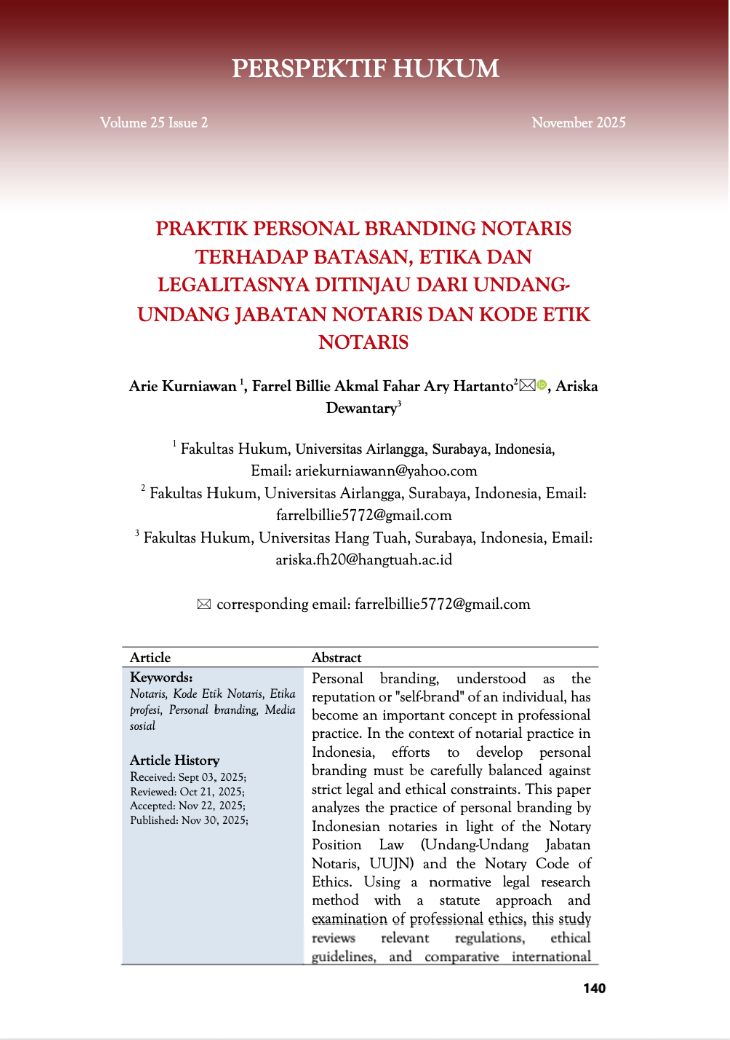
Praktik Personal Branding Notaris terhadap Batasan, Etika dan Legalitasnya ditinjau dari Undang-Undang Jabatan Notaris dan Kode Etik Notaris
Notary Personal Branding Practices in Relation to Their Limitations, Ethics, and Legality as Reviewed from the Notary Position Law and Notary Code of Ethics
DOI:
https://doi.org/10.30649/ph.v25i2.498Keywords:
Notary, Notary Code of Ethics, Professional ethics, Personal branding, Social mediaAbstract
Personal branding, understood as the reputation or "self-brand" of an individual, has become an important concept in professional practice. In the context of notarial practice in Indonesia, efforts to develop personal branding must be carefully balanced against strict legal and ethical constraints. This paper analyzes the practice of personal branding by Indonesian notaries in light of the Notary Position Law (Undang-Undang Jabatan Notaris, UUJN) and the Notary Code of Ethics. Using a normative legal research method with a statute approach and examination of professional ethics, this study reviews relevant regulations, ethical guidelines, and comparative international practices. The findings indicate that while notaries may engage in certain reputational activities such as legal education or informational outreach, direct self-promotion is prohibited. Article 15 paragraph (2) letter e of the Notary Position Law explicitly grants the authority to provide legal counseling which can enhance reputation, but Article 4 paragraph (3) of the Notary Code of Ethics forbids any form of advertising or personal publicity. International comparisons from Spain and France reveal similarly restrictive rules for notary advertising. In conclusion, Indonesian notaries must perform personal branding within the narrow confines allowed by law and ethics, emphasizing professional expertise and public education while avoiding any media-based promotion of their notarial status. These findings aim to guide notaries in promoting their professional image without violating legal or ethical boundaries.
Downloads
References
Febriana, Rani. “Konsep Cyber Notary sebagai Upaya Perlindungan Konsumen.” Skripsi, Universitas Islam Negeri Jakarta, 2023.
Hendardini, Raden Roro Citra. “Notaris dan Personal Branding dalam Menjalankan Jabatan Notaris.” Master’s thesis, Universitas Indonesia, 2021.
Herman, M. Vanessa. “Makna Kehormatan Notaris Dalam Penggunaan Media Sosial.” Master’s thesis, Universitas Wiraraja, 2025.
Ikatan Notaris Indonesia. Kode Etik Notaris Hasil Perubahan KLB INI Banten 29–30 Mei 2015. Jakarta: Ikatan Notaris Indonesia.
Marzuki, Peter Mahmud. Penelitian Hukum. Jakarta: Kencana, 2019.
Soekanto, Soerjono, dan Sri Mamudji. Penelitian Hukum Normatif: Suatu Tinjauan Singkat. Jakarta: RajaGrafindo Persada, 2015.
Tan, Thong Kie. Studi Notariat dan Serba-Serbi Praktek Notaris. Jakarta: PT Ichtiar Baru van Hoeve, 2007.
Abdillah, Maulana Farhan. “Etika Notaris Dalam Era Digital: Dampak Branding Diri Dalam Profesionalitas Notaris.” Jatiswara 1, no. 1 (2025). https://jatiswara.unram.ac.id/index.php/js/article/view/1171.
Akrabi, M. M. R. I. S. “Pemanfaatan Sosial Media oleh Notaris Sebagai Sarana Melaksanakan Kewenangan Notaris.” UNES Law Review 6, no. 2 (2023). https://review-unes.com/index.php/law/article/view/1237.
Borman, M. Syarul. “Kedudukan Notaris Sebagai Pejabat Umum.” Jurnal Hukum dan Pembangunan Ekonomi 7, no. 2 (2019).
Kristiawan, Y. “Penegakan Kode Etik Notaris Sebagai Upaya Menjaga Kehormatan dan Keluhuran Jabatan Notaris.” Adil: Jurnal Hukum 13, no. 1 (2023). https://doi.org/10.33476/ajl.v13i1.2085.
Kurniasari, Cindy, dan Aju Putrijanti. “Pelanggaran Pidana oleh Notaris: Urgensi Peningkatan Kesadaran dan Pemahaman Etika Profesi.” Inovasi: Jurnal Penelitian Manajemen dan Bisnis 4, no. 1 (2025). https://doi.org/10.55606/inovasi.v4i1.4236.
Noviyanti, Tri, dan Edith Ratna M. S. “Akibat Hukum Notaris Mempromosikan Diri di Sosial Media Instagram.” Notarius: Jurnal Kenotariatan 15, no. 2 (2022). https://ejournal.undip.ac.id/index.php/notarius/article/view/33674.
Nurarifah, Raden Ajeng Herning, dan Luqman Hakim. “Perlindungan Hukum Dari Negara Terhadap Notaris Yang Diakui Sebagai Officium Nobile.” Socius: Jurnal Penelitian Ilmu-Ilmu Sosial 1, no. 9 (2024). https://doi.org/10.5281/zenodo.11067821.
Ramadhandiko, Difqa Alvi, dan Kayus Kayowuan Lewoleba. “Tinjauan Yuridis Pemanfaatan Media Sosial sebagai Sarana Promosi Online oleh Notaris sebagai Pelanggaran Kode Etik.” Media Hukum Indonesia 3, no. 3 (2025).
Renaldi, Fredy. “Perbandingan Publikasi dan Promosi Diri oleh Notaris di Indonesia dan Negara Lain.” Swara Justisia: Jurnal Keadilan dan Hukum 1, no. 1 (2024). https://swarajustisia.unespadang.ac.id/index.php/UJSJ/article/view/478.
Siahaan, Kevin Mikail. “Prohibition of Self-Promotion in the Notary Code of Ethics and Notary Position Law.” Asian Journal of Education and Social Studies 1, no. 1 (2024). https://ajesh.ph/index.php/gp/article/download/492/696.
Yudhoyono, Gatot Eko, dan Yunanto. “Peran Kode Etik Profesi Notaris dalam Menjaga Martabat Jabatannya sebagai Pejabat Umum.” Notarius: Jurnal Kenotariatan 18, no. 3 (2025). https://doi.org/10.14710/nts.v18i3.69433.
Yuniati, Sri, dan Sri Endah Wahyuningsih. “Mekanisme Pemberian Sanksi Terhadap Notaris Yang Melakukan Pelanggaran Kode Etik Jabatan Notaris.” Jurnal Akta 4, no. 4 (2017).
France. Règlement National du Notariat (Règlement Professionnel du Notariat – RPN). Paris: Government Publishing Office.
Indonesia. Undang-Undang Nomor 30 Tahun 2004 tentang Jabatan Notaris (Lembaran Negara Republik Indonesia Tahun 2004 Nomor 117).
Indonesia. Undang-Undang Nomor 2 Tahun 2014 tentang Perubahan Atas Undang-Undang Nomor 30 Tahun 2004 tentang Jabatan Notaris (Lembaran Negara Republik Indonesia Tahun 2014 Nomor 3).
Spain. Notarial Regulations. Article 71. Madrid: Government Publishing Office.
Spain. Notarial Association of Catalonia: Internal Regulations. Article 24. Barcelona: Colegios de Notarios de Cataluña.
Downloads
Published
How to Cite
License
Copyright (c) 2025 All writings published in this journal are personal views of the authors and do not represent the views of this journal and the author's affiliated institutions. Author(s) retain copyrights under the licence of Creative Commons Attribution-ShareAlike 4.0 International (CC BY-SA 4.0).

This work is licensed under a Creative Commons Attribution-ShareAlike 4.0 International License.